 report for may Washington – DC USA-Retail-Market-2026-07-03
Market Report of Residential, June 2026 report click
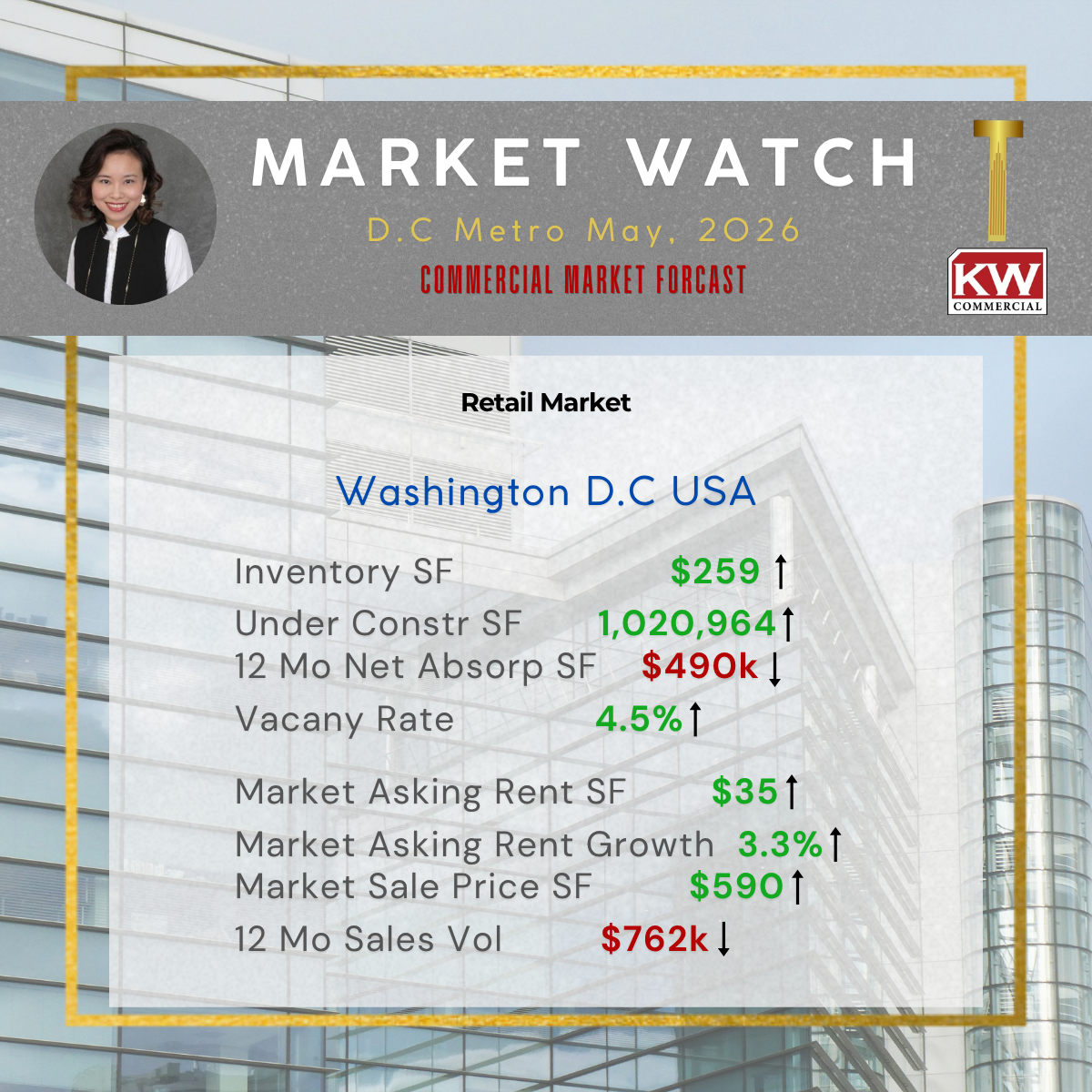
Washington D.C.’s retail market remains historically tight, supported by strong household incomes and steady population growth. As of 2026Q3, the region’s availability rate is 5.1%, among the lowest since 2008. However, early signs of softening are emerging amid macroeconomic uncertainty, shifting retailer sentiment,and potential declines in consumer spending, which are weighing on demand. Net absorption is negative for the trailing 12 months at -490,000 SF, driven by large store closures and scaled-back expansion plans in response to federal job cuts, tariffs, and broader headwinds. Market fundamentals remain healthy, but the divide between suburbs and the urban core is pronounced. Northern Virginia posts the lowest availability rate (4.0%), followed by Suburban Maryland at 5.9%, while the District of Columbia lags at 8.8%, reflecting a slower recovery in the urban core. Suburban submarkets, especially in Northern Virginia, benefit from ongoing
population and job growth, while the District faces headwinds from slow office re-occupancy and federal government issues. There have also been a large number of restaurant closings in D.C. in the last year.
Leasing activity has dropped from the strong results in 2024, when over 6.7 million SF was leased, the highest annual total since 2011. Volume declined in 2025 and will likely end up closer to 5.3 million SF. The first quarter of 2026 was roughly in line with quarterly leasing in late 2024 and 2025. Recent leasing is concentrated in service-oriented categories such as gyms, wellness
centers, and restaurants. Class A and renovated centers in affluent submarkets continue to lease quickly and maintain low vacancy.
New supply remains limited. Construction starts hit an 18-year low in 2024, and while activity has picked up slightly in 2026, only 1.0 million SF is underway, approximately 0.4% of inventory. The largest project is the redevelopment of the demolished Lakeforest Mall in Gaithersburg. Most new developments are small strip centers, restaurants, and freestanding retail.
Rent growth has normalized. Asking rents reached a record $35.00/SF NNN, up 3.3% year-over-year, matching the region’s 10-year average and higher than the national rate of 1.7%. Rent growth is strongest in the suburbs, with Suburban Maryland at 3.2% and Northern Virginia at 3.6%, followed by the District (1.4%). Prime corridors like U Street and Georgetown command rents
above $80/SF NNN, with select deals exceeding $150/SF.
Modest population growth should support steady demand through 2026, but risks remain from federal layoffs, slower private-sector job growth, softer consumption, and policy shocks. Limited new supply and strong household fundamentals should keep vacancy low and rent growth in line with national averages, though the market remains sensitive to broader economic shifts.